by Mike Peercy, Executive Director of Fostering Grace
I’ve been wrestling with this notion for a few years now. It’s one of those very short statements with very large implications for those of us who engage with, care for, and seek to serve people. (Yes, I do realize that means all of us.)
Consider it with me for a moment:
Behavior is language.
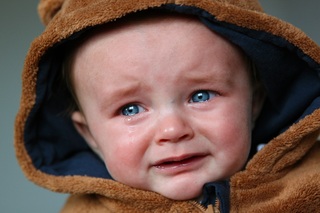
From our earliest moments of life outside the womb, our only means of expression—of communicating some need we feel—is simply to cry. From our first hours we quickly perceive that our needs must be expressed in order to be met. We feel the discomfort of hunger and we cry and that (hopefully) attentive caregiver comes to our aid and brings us nourishment. We feel the discomfort from a saturated or soiled diaper and we cry and an attentive caregiver comes and soothes this discomfort with a clean diaper and gentle words that we don’t understand—but we feel.
The same is true with all of our needs—to be warmed, to be swaddled, to be rocked, to be held, to be attended—that a caring person brings their warmth, their skill, their resources, and most importantly their presence to meet our need and calm our fear. Having not yet developed the parts of our brain that recognize words and formulate sentences, we depend entirely on the only language we have. We have only the language of behavior.
As we grow and our bodies and brains develop, we begin to learn words, to recognize our names, to ask for our needs by the terms assigned thereto. But it’s a journey. And when our little nervous systems are dysregulated by some need, it’s natural to default to our first language—the language of behavior.
This all seems sensible enough, right?
But it’s easy to overlook the fact that our truly native language (true to all humanity, I would suggest) is that of behavior. We know that, in moments of dysregulation—moments of stress, fear, or crisis—it is natural to revert to our most innate form of expression. Like someone under stress may stop translating for themselves and speak only their native language, all humanity can easily default to the body’s most primal language, the language of behavior.
So what does this mean for us as we navigate this world full of humans? It means we need to adjust our lens of observation.
If we can approach behavior that doesn’t seem rational or sensible to us with curiosity instead of jumping to conclusions, we will find a much more compassionate and gracious way of living.
But let’s be honest. Google Translate is not going to help us with this one. Our own experiences, even as broad as they might be, will never fully overlap with another person. Our assumptions about rational decisions will never entirely align with another individual. But what if we could start with the basic assumption that every behavior makes sense to the person in that moment?
What if could approach people with curiosity to understand rather than criticism?
Would it make us slower to label someone as foolish or stupid? If so, that’s a good thing. No matter how stupid someone may seem, the fact is that they know some things that you and I do not.
Would it help us to become more compassionate and kind to those whose behaviors are puzzling to us? There are certainly things we don’t know or understand about their choices.
If we accept that behavior is language, won’t it make us kinder, gentler people if we seek to interpret the language instead of judging what we don’t understand?
Like I said, it’s a short phrase with deep implications.
Behavior is language.
 Fostering Grace
Leave a comment